
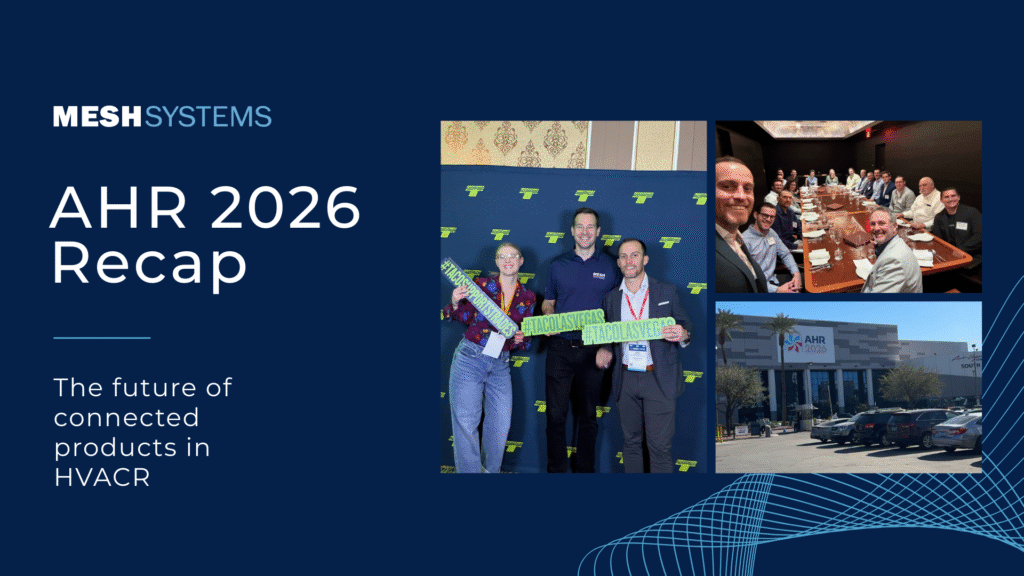
This year’s AHR Expo in Las Vegas brought the HVACR industry together at a moment of real transition. Mesh Systems was on the ground, meeting with product, engineering, and digital leaders across the exhibit floor and hosting a product leadership dinner in partnership with Exein at Bazaar Meat by José Andrés.
The dinner brought together leaders from companies including Rheem Manufacturing, GE Appliances, Badger Meter, Bradford White, Watts Water Technologies, Steffes, RenewAire, and others for candid conversation about where connected products are delivering value and where they’re still falling short.
Across those conversations, and reinforced by product announcements, press releases, and official AHR coverage, several clear themes emerged. Together, they point to a market that has moved beyond experimentation and is now grappling with how connected products perform at scale.
Connectivity is no longer the differentiator
Connectivity itself is no longer the headline. Nearly every major manufacturer now offers connected equipment, remote monitoring, or cloud visibility. Instead, there is an increasing focus on what happens after the data is collected.
Product announcements increasingly emphasized system-level intelligence and operational impact rather than raw telemetry. For example, GE Appliances highlighted connected ecosystems that tie water heaters, leak detection, and monitoring into unified experiences designed to reduce risk and improve operational decision-making, not just surface alerts. Similarly, official AHR Expo previews and show coverage emphasized intelligence and optimization as baseline expectations for modern HVACR systems.
The message from the show floor was consistent: OEMs are being pushed by customers and internal stakeholders alike to prove that connected products increase performance, reliability, and cost outcomes.
AI is expected, but execution remains inconsistent
Artificial intelligence was everywhere at AHR 2026. From keynote sessions to booth messaging, AI and “smart” capabilities were positioned as central to the next generation of HVACR systems. The official AHR education program leaned heavily into AI-driven controls, predictive maintenance, and adaptive optimization as key enablers of efficiency and resiliency.
Large vendors reinforced this direction through public announcements. Siemens, for example, showcased AI-enabled building technologies designed to reason over system data and support more autonomous operations. Others highlighted machine-learning-driven optimization across heating, cooling, and water systems.
At the same time, the breadth of AI messaging exposed a gap. While AI is widely expected, many solutions remain narrowly focused, optimizing individual components or generating more alerts rather than helping teams confidently act on insights. The industry’s next challenge is not adopting AI but operationalizing it in ways that meaningfully reduce manual effort and decision friction.
Connected products are evolving into connected ecosystems
Another defining trend from AHR 2026 was a shift toward system-first design. Connectivity is increasingly being used to unify devices, controls, and applications into cohesive platforms rather than treating each product as an independent node.
This was reflected in several public product announcements. Copeland emphasized connected controls and integrated system architectures spanning refrigeration and HVAC environments. Bradford White Corporation highlighted a coordinated portfolio of residential and commercial water heating and hydronic solutions, positioning its lineup as a cohesive system designed to support consistent performance, installation, and service across applications.
Across the show, interoperability and data integration were recurring themes. Manufacturers are clearly responding to customer demand for fewer silos, simpler operations, and clearer system-level understanding, especially as building portfolios and installed bases continue to grow.
Sustainability, efficiency and compliance are core drivers
Many of the most visible announcements at AHR 2026 paired connectivity with efficiency, electrification, and long-term performance goals. Increasingly, connected products are being positioned as the mechanism for measuring and sustaining those outcomes over the full lifecycle of deployed equipment.
Rheem Manufacturing’s sustainability roadmap announcement was a clear example, framing connected products as tools for tracking performance, optimizing energy use, and supporting long-term environmental targets. Across the show, efficiency claims were more frequently backed by data, monitoring, and analytics rather than static specifications or nameplate ratings.
At the same time, these outcomes are now inseparable from cybersecurity and regulatory readiness. As connected devices become more prevalent in commercial buildings and infrastructure environments, manufacturers are expected to ensure secure data flows, protect long-lived fielded assets, and support evolving compliance requirements alongside energy and sustainability goals. The result is a broader shift: connected products are no longer just supporting service and maintenance, but enabling energy management, sustainability reporting, and compliant, trusted operation at scale.
Looking ahead
AHR Expo 2026 made one thing clear: the connected product market has entered a more mature phase. The conversation has moved past “Can we connect this?” to harder questions about cost, scale, intelligence, and value delivery. OEMs are investing heavily, but they’re also scrutinizing how platforms, architectures, and partners support long-term outcomes.
We’d also like to extend a sincere thank you to Exein for partnering with us on our product leadership dinner and helping bring together such a thoughtful group of product and technology leaders. The conversations that happen off the show floor are often the ones that shape what comes next, and this year was no exception.
If you’d like to continue the conversation about connected products, system intelligence, or where the market is heading next, we’d welcome the opportunity to connect.