
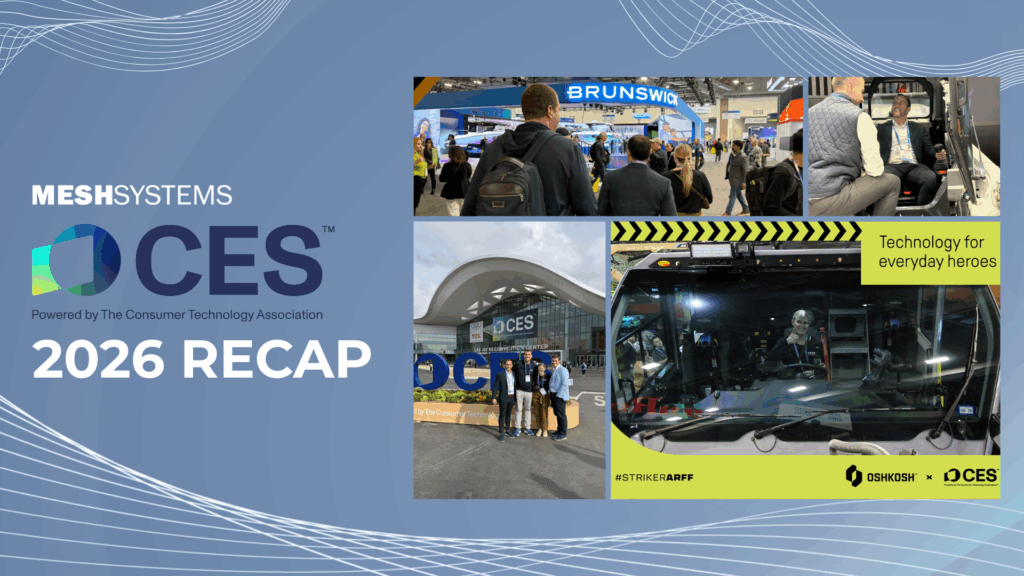
CES 2026 reinforced a shift that has been building quietly across industrial and connected-product organizations for years. The industry has moved past the novelty of connectivity and dashboards and is now grappling with a more fundamental challenge: how decisions are made, how they scale, and how much trust operators place in the systems that make them.
The Mesh Systems team spent the week immersed in meetings, show-floor conversations, and relationship building. Between packed schedules, valuable client conversations, and team building over steaks in a booth once favored by John Wayne, one theme came through consistently: intelligence is moving into products themselves, and expectations for reliability, safety, and operational impact are rising fast.
Here are five signals from CES 2026 that stood out the most.
1. AI Still Functions as an Operator Assistant
One of the clearest themes at CES was how AI is being positioned inside real products. Rather than promising full autonomy, leading companies are introducing AI to support operators by simplifying complexity and improving decision quality.
Caterpillar demonstrated this approach with the introduction of its Cat AI Assistant, a conversational interface that aggregates information across machines and surfaces recommendations while keeping humans firmly in control. Similarly, Bobcat showcased AI-enabled jobsite assistance focused on safety, service, and guidance rather than autonomous replacement. In a different domain, Brunswick revealed its most technology-rich Sea Ray to date, embedding intelligence directly into the helm experience and positioning software as part of how operators interact with their boats.
AI is being productized to reduce cognitive load, but across industries, the same constraint keeps appearing: while data is abundant, expert reasoning still lives largely in people’s heads. That gap between signal and trusted action is exactly the problem MeshInsights was created to address: using AI to automate the reasoning step between sensing and acting, freeing up experts to focus on larger, more strategic initiatives.
2. The Edge Is Becoming the Primary Decision Boundary
Another strong signal from CES was the growing emphasis on where decisions happen, not just where data is collected. Semiconductor providers are designing for intelligence that lives closer to the device.
NXP highlighted edge platforms built for secure, local decision-making, while STMicroelectronics introduced new microprocessor offerings to enable more capable industrial edge systems. Silicon Labs reinforced this direction with its CES showcase around edge-ready development and real-time responsiveness.
Together, these announcements point to a shift away from cloud-dependent architectures toward systems designed to operate through latency, bandwidth constraints, and intermittent connectivity. Rather than being viewed as an optimization, edge intelligence is now a baseline expectation.
3. Autonomy Is Advancing Incrementally, and Trust Is the Gating Factor
CES 2026 also reinforced a more pragmatic reality about autonomy: it succeeds when it is introduced gradually and purposefully rather than all at once.
Kubota highlighted this approach by showcasing autonomous tractors and modular robotic platforms designed for specific agricultural environments. The emphasis was on targeted use cases where automation can be trusted and validated in the field.
This same incremental mindset was visible in how Oshkosh framed its CES presence, focusing on autonomy, electrification, and intelligent systems within controlled, mission-critical environments such as airports, fire stations, and industrial operations. Rather than overselling autonomy, the message centered on reliability, safety, and systems that can be operationalized at scale.
To the Mesh team, it was clear that autonomy isn’t limited by technology. Rather, it’s being introduced gradually as confidence increases. Teams are moving faster by automating decision support first, then expanding toward automation as trust builds. This progression mirrors how MeshInsights approaches automation: encode expert judgment, validate outcomes, and automate action only when proven in production environments.
4. Security and Trust Are Shifting Down the Stack
As intelligence moves closer to devices, CES highlighted how security is following it downward in the architecture.
Kudelski Labs emphasized embedded and edge security designed specifically for AI-enabled systems, underscoring the importance of protecting devices that reason and act locally. Clarios reinforced this theme from an infrastructure perspective, highlighting how long-lived energy systems demand security models that span manufacturing, deployment, and years of operation.
The takeaway is clear: security is no longer a cloud-only concern. Device identity, firmware integrity, and secure lifecycle management are becoming foundational design constraints. To our customers, this has been a meaningful topic well before CES, covered last year during our webinar with DigiCert on device security and digital trust.
5. Connected Products Are Being Positioned as Business Platforms
Finally, CES 2026 made it clear that connected products are increasingly being viewed as customer-facing business platforms rather than internal engineering achievements.
Conversations with our friends at Eaton emphasized electrification and system-level intelligence as long-term value drivers, while Brunswick’s Sea Ray launch tied intelligence directly to brand and the ownership experience. Kubota’s autonomy messaging similarly connected technology investments to labor efficiency and measurable outcomes.
Across the board, connectivity, intelligence, and data flow are now strategic business decisions that shape service models, differentiation, and scalability.
Beyond the Show Floor
CES is ultimately as much about relationships as it is about technology. One highlight of the week was Connected Devices + Conversations, a happy hour sponsored by Mesh Systems and hosted by SEACOMP, which brought together OEMs, platform providers, and product leaders for candid, peer-driven discussions away from the show floor noise.
Those conversations reinforced an important truth: the next generation of connected products will be built not just through innovation, but through thoughtful collaboration across the ecosystem.
CES 2026 didn’t deliver a single breakthrough moment. Instead, it validated a broader shift already underway: the future of connected products depends less on collecting more data and more on scaling sound judgment inside systems people trust.