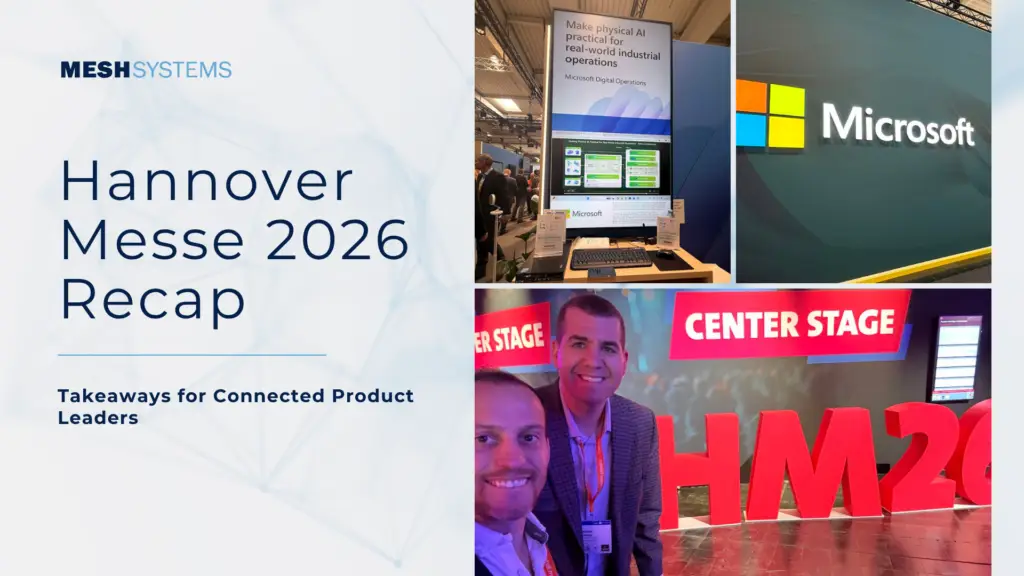
Last week, Mesh Systems CEO Andrew Cohoat and Director of Business Development Dan Morrow traveled to Hannover Messe 2026 to meet with manufacturers, partners, and technology leaders from around the world.
As one of the world’s largest industrial technology trade shows, Hannover Messe has long been a signal for where the market is heading. This year, the message was clear. The conversation is evolving beyond simply connecting devices toward operationalizing data, AI, and automation. While at the show, the Mesh team also met with our partners at Microsoft and highlighted our perspective on industrial connectivity, modern cloud architectures, and the growing role of AI in connected product ecosystems. Microsoft’s own Hannover Messe messaging echoed many of the same themes, with a focus on “industrial intelligence,” AI agents, and data-driven operational transformation.
Here are four trends we observed across the show floor, in conversations, and in the broader market discussion surrounding Hannover Messe 2026.
1. Industrial AI Is Becoming Practical
Artificial intelligence was a dominant theme at Hannover Messe this year, but the messaging has become more practical and more specific.
Across exhibitor announcements and product showcases, the focus was on applying AI to solve operational challenges. Companies highlighted use cases such as predictive maintenance, anomaly detection, intelligent service operations, and decision support. NVIDIA showcased AI-powered manufacturing innovations, Lenovo introduced AI solutions designed to improve efficiency and resilience, and broader media coverage focused on robotics and automation moving closer to real-world deployment. Microsoft’s announcements similarly emphasized AI agents and connected data systems that help industrial organizations move faster from insight to action.
For connected product companies, this shift is especially important. Connected devices generate massive volumes of telemetry and operational data, but many organizations still struggle to translate that information into timely decisions. AI is increasingly being positioned as the layer that helps teams interpret complex data, identify patterns, and take action faster.
2. Connectivity Is Expected. Outcomes Are the Priority.
A second major theme at the show was the changing role of connectivity in the conversation.
For many manufacturers and OEMs, connecting devices and collecting telemetry is no longer the differentiator. Most organizations have already made significant investments in visibility, dashboards, and data infrastructure. The next question is how to create measurable business value from that foundation.
In conversations throughout the week, the most common priorities were improving uptime, increasing operational efficiency, reducing service costs, creating new service or revenue opportunities, and improving the customer experience. These are business conversations, not infrastructure conversations.
This reflects what we continue to see across the market. The challenge is no longer collecting more data. The challenge is operationalizing insights and automating action. That is where the last mile of connected product ROI is won or lost.
3. Industrial Connectivity and Data Infrastructure Are Being Reimagined
As organizations connect more devices, systems, and environments, integration complexity remains a major challenge.
At Hannover Messe, there was significant interest in simpler and faster ways to unify operational technology environments with cloud platforms and AI ecosystems. Kubernetes-native edge technologies, flexible data architectures, and modern cloud platforms were recurring themes in both product announcements and private conversations.
Organizations are also reevaluating legacy platforms and fragmented architectures as they look for more flexible ways to connect devices and operationalize data. Many are searching for architectures that reduce complexity, improve scalability, and create cleaner paths to AI adoption.
This trend reinforces a broader industry shift toward edge-to-cloud architectures that are more modular, interoperable, and easier to evolve over time.
4. Repeatable, Outcome-Driven Use Cases Are Winning
The companies making the most progress with AI and connected product innovation are starting with focused, repeatable use cases.
Across conversations and market messaging, the strongest examples centered on solving specific operational problems. Alert and alarm triage, anomaly detection, predictive service workflows, remote device management automation, and proactive service and sales opportunities were all common themes.
This approach makes adoption easier and accelerates time to value. It also creates a clearer path to scaling. Rather than launching broad transformation initiatives, organizations are proving value one workflow at a time and expanding from there.
This aligns with the way many connected product leaders are evaluating investments today. They want solutions tied to measurable business outcomes with a practical path to implementation.
What This Means for Connected Product Leaders
For product, digital, and engineering leaders, the takeaway from Hannover Messe 2026 is straightforward.
The next wave of innovation is centered on turning connected product data into measurable business outcomes. Organizations that lead in this next phase will build scalable data foundations, prioritize outcomes over infrastructure-first conversations, identify repeatable workflows for automation, and modernize platforms that may be slowing innovation.
At Mesh Systems, we see the future of connected products taking shape at the intersection of industrial connectivity, scalable cloud infrastructure, and AI-driven automation. Whether organizations are modernizing connectivity, scaling connected product platforms, or operationalizing device data with AI, the goal remains the same: turning connected devices into connected outcomes.
To learn how leading OEMs and manufacturers turn connected product data into measurable business outcomes, download Mesh’s latest ebook: