
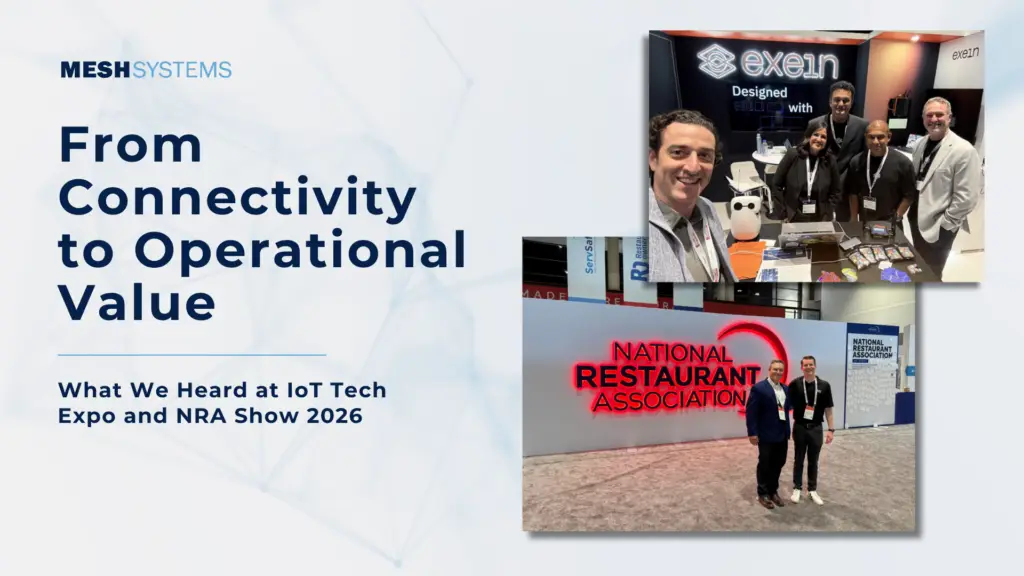
Last week, members of the Mesh Systems team attended both IoT Tech Expo North America and the National Restaurant Association Show. While the audiences and industries differed, many of the conversations pointed to the same broader reality across the connected product market.
The conversation is no longer centered on whether products should be connected. Most companies already have telemetry, remote monitoring, or cloud infrastructure in place. The bigger challenge now is figuring out how to operationalize connected product data in ways that improve service, customer experience, and long-term business performance.
Across both events, we saw several themes continue to emerge.
The Market Is Moving Beyond Visibility Alone
At both shows, companies talked less about simply collecting device data and more about what happens after the data arrives.
Organizations are trying to determine how connected product investments translate into measurable operational value. That includes improving uptime, enabling proactive service, reducing support burden, expanding maintenance offerings, and helping internal teams prioritize the right actions faster.
This was especially visible at the National Restaurant Association Show, where many equipment manufacturers discussed opportunities around predictive maintenance, maintenance workflows, service optimization, and customer support experiences tied to connected equipment.
That’s an important shift from some of the conversations we heard earlier this year at CES and Hannover Messe, where much of the discussion centered around infrastructure modernization, industrial AI momentum, and the acceleration of connected product adoption more broadly. At NRA, the conversation felt more operational and outcome-focused. Many companies are now asking how they can use connected product data to improve the business after deployment, not just the product itself.
AI Messaging Is Starting to Mature
AI was impossible to avoid at IoT Tech Expo. Nearly every company had some version of an AI, automation, or agentic workflow story.
Mesh Systems partnered with Exein at their booth during the event, which created a lot of interesting conversations around IoT security, operational readiness, and what organizations actually need to support AI-enabled connected systems at scale.
What stood out most, though, was that buyers are becoming more skeptical of broad AI messaging. The strongest conversations were highly specific and operational.
Instead of asking about AI in general, companies were discussing questions like:
- How do we prioritize service issues automatically?
- How do we reduce unnecessary technician dispatches?
- How do we identify equipment trends across fleets?
- How do we help support teams make faster decisions?
- How do we operationalize insights inside existing workflows?
That evolution matters. Earlier this year, many event conversations still centered on AI experimentation and exploration. At IoT Tech Expo, the tone felt more pragmatic. Companies increasingly want AI tied to measurable operational outcomes, particularly in environments involving connected equipment, telemetry, and service operations.
Security Is Becoming Part of Connected Product Readiness
Security also remained a major topic throughout IoT Tech Expo. Conversations consistently touched on firmware visibility, device compliance, secure connectivity, and operational lifecycle management.
What continues to stand out is that security is increasingly being viewed as part of overall connected product readiness rather than a standalone initiative.
As connected product programs mature, companies are realizing they need long-term operational strategies around:
- Device onboarding
- Certificate management
- Firmware updates
- OTA infrastructure
- Monitoring and support
- Lifecycle management
That operational maturity was a recurring theme across both events. Companies are increasingly recognizing that launching a connected product is only the beginning. The long-term challenge is maintaining, scaling, securing, and evolving those systems over time.
The Physical Layer Still Slows Down IoT Initiatives
One of the more consistent themes across both events was that the physical realities of IoT remain difficult.
At IoT Tech Expo, vendors focused heavily on connectivity infrastructure, edge deployment flexibility, LoRa, satellite IoT, and eSIM technologies.
At NRA, many conversations revolved around retrofit equipment, compliance concerns, embedded hardware decisions, and integrating connectivity into existing operational environments.
This reinforces something we continue to see across the market: many organizations still need guidance navigating the tradeoffs between hardware, firmware, connectivity, cloud architecture, and operational scalability.
That challenge becomes even more complex as organizations try to scale beyond isolated pilots and into broader commercial deployments across product lines, customer environments, and geographic regions.
The Connected Product Market Continues to Mature
The clearest takeaway from both events was that the market is continuing to mature beyond foundational IoT conversations.
Companies are increasingly focused on:
- Operationalizing connected product data
- Supporting proactive service models
- Improving customer retention and uptime
- Scaling securely
- Reducing operational friction
- Turning telemetry into actionable workflows
There is still plenty of AI hype across the industry. But the companies gaining traction appear to be the ones focused on applying connected product data to real operational problems in ways that teams can actually use.
That shift aligns closely with where we see the market heading next.
If your organization is trying to move beyond dashboards and alerts and turn connected product data into measurable operational outcomes, explore our ebook, “The Last Mile of Connected Product ROI”: