
Consider a 200-device pilot scaling to 15,000 units. The dashboard works. The alerts fire. The firmware is solid. What breaks is everything the pilot never needed: provisioning takes three days per device, twin updates saturate IoT Hub, and nobody can tell which devices are offline because the observability story stops at the load balancer. The technology isn't the problem. The architecture is.
Summary
Industry estimates suggest 60–75% of IoT initiatives never move past the pilot phase. This post examines the six most common architectural failure modes at scale, draws from deployment patterns on Azure, and provides a concrete checklist architects can use before promoting an IoT solution to production. If you are standing at the edge between pilot and production right now, this post will tell you whether you are ready.
The Seductive Simplicity of the PoC
Every IoT project begins the same way: a small team connects a handful of devices to Azure IoT Hub, routes telemetry to a database, and builds a dashboard. It works. Stakeholders are impressed. The question becomes: “How long until production?”
The dangerous assumption is that scaling from 50 to 50,000 devices is a matter of provisioning more resources. In reality, the architecture that serves a pilot is often structurally incapable of supporting production. The gap is not computational — it is architectural.
Consider what a typical PoC skips because “nothing at this scale needs that yet”:
- Zero-touch provisioning. Each device is manually registered in the Azure portal with a connection string copied from the blade.
- Security hardening. Devices authenticate with symmetric keys. Certificates are self-signed. No rotation plan exists.
- Fleet monitoring. Nobody tracks how many devices are online, how many messages are dropping, or how long processing takes end-to-end.
- Cost modeling. Cloud costs are estimated by multiplying the current bill by the target device count.
- Firmware update mechanism. “We’ll stabilize the firmware before production,” the team says.
Each of these is reasonable for 50 devices. Collectively, they make 50,000 devices impossible.
The Six Failure Modes
We’ve seen IoT initiatives stall for dozens of reasons, but six architectural failure modes account for the majority. Each one looks reasonable during pilot planning. None of them survives contact with fleet-scale reality.
1. The Proof-of-Concept Trap
The pilot architecture skipped provisioning automation, security hardening, fleet monitoring, cost optimization, and operational tooling. The team treated these as features to add later. They are not features — they are the architecture itself.
Consider a medical-devices project where the PoC impressed everyone with a clean dashboard and sub-second alerting. The team spent three weeks proving the concept and zero weeks building the provisioning pipeline. Twelve months later, they were still manually registering devices in the Azure portal one at a time. The project was reassessed and put on hold.
The concrete test: Can a new engineer provision 100 devices without copying a single connection string by hand? If the answer is no, the PoC is not production-ready.
Before you scale: Treat the PoC as a learning exercise, not a foundation. Run a Well-Architected Framework assessment before promoting any architecture to production. (See Post 5 in this series for a practitioner’s view of the WAF applied to IoT.)
2. The Monolithic Device Cloud
All device communication, business logic, storage, and presentation live in a single application. It works beautifully until a telemetry spike starves command processing or a slow dashboard query blocks device management.
This pattern typically emerges when a small team builds the entire backend in a single web application “to move fast.” In the early stages, it works well — a single codebase is easy to understand, deploy, and debug. But IoT workloads have wildly different scaling profiles:
|
Workload
|
Throughput Profile
|
Latency Requirement
|
Scaling Trigger
|
|---|---|---|---|
|
Telemetry Ingestion
|
High-volume, write-heavy
|
Seconds acceptable
|
Messages per second
|
|
Command processing
|
Low-volume, critical
|
Sub-second required
|
Active commands queued
|
|
Dashboard rendering
|
Read-heavy, cacheable
|
< 2 seconds for UX
|
Concurrent users
|
When these concerns share a single process, the highest-volume workload starves the others. A flood of telemetry during a weather event (all temperature sensors reporting simultaneously) can make the command channel unresponsive, precisely when operators need it most.
Before you scale: Adopt a layered architecture with independent scaling at each layer. (Another post in this series will dive deep into the five-layer model.)
3. The Security Afterthought
Devices are deployed with symmetric keys and shared credentials. Certificate rotation is deferred to “Phase 2.” Then a competitor’s devices are found replaying authentication tokens. Your team realizes retrofitting X.509 into 50,000 deployed devices means either a costly OTA campaign or physical truck rolls.
The cost of this mistake deserves a real number. If you deploy 50,000 devices with symmetric key authentication and later decide to migrate to X.509 certificates, you face two options:
- Send a firmware update that changes the authentication mechanism — which requires that you already have a working, secure OTA update channel (which you probably do not, because security was deferred).
- Physically touch every device to re-provision it.
At a conservative estimate of $75 per truck roll, that is $3.75 million in remediation costs. The cost of implementing certificate-based authentication from day one — including the DPS enrollment infrastructure and certificate lifecycle management — is a fraction of that.
Here is the DPS enrollment group configuration that enables zero-touch provisioning with X.509, the pattern we use at Mesh:
{
“enrollmentGroupId”: “mesh-prod-cohort-a”,
“attestation”: {
“type”: “X509”,
“identityCertificates”: [],
“signatureVerificationCertificate”: “cn=dps-signing-ca.meshsystems.internal”,
“initialTwin”: {
“tags”: {
“cohort”: “A”,
“provisionedDate”: “2025-01-15”
}
}
},
“iotHubUri”: “mesh-prod-iothub.azure-devices.net”,
“allocationPolicy”: “hashed”,
“priority”: 10,
“provisioningStatus”: “enabled”
}
This enrollment group allows any device with a certificate signed by the specified CA to join the fleet automatically. No human intervention. No connection string copy-paste.
Before you scale: Design security from day one. Use X.509 certificates or TPM-based attestation through Device Provisioning Service. (Another post in this series will cover device identity.)
4. The Cost Surprise
Cloud costs are estimated based on current device counts and naive message sizes. When the fleet grows tenfold, IoT Hub’s 4KB message billing boundary, twin update overhead, and un-tiered storage compound into what has been described as “the Azure equivalent of a cardiac event.”
Here is a worked example of how this unfolds. A team deploys 10,000 devices, each sending a 1KB message every 30 seconds:
|
Cost Component
|
Naive Estimate
|
Actual (What They Missed)
|
|---|---|---|
|
Messages/day per device
|
288
|
288 telemetry + 14 twin updates + 6 diagnostic = 304
|
|
Total messages/month
|
86.4M
|
91.2M telemetry + 4.2M twin + 1.8M diagnostic = 97.2M
|
|
IoT Hub billing (4KB units)
|
86.4M @1KB each
|
97.2M @ 4KB each (1KB padded to 4KB)
|
|
Storage (all hot tier)
|
$1,500/mo
|
$4,800/mo (no lifecycle policy)
|
|
Stream processing (100%)
|
$3,200/mo
|
$3,200/mo (80% of data does not need real-time)
|
The naive estimate: ~$6,700/month. The actual bill: ~$14,200/month — more than 2x the estimate, and the gap widens non-linearly as the fleet grows.
The fix is not to choose different Azure services. It is three architectural changes:
- Batch messages at the source. Combine 10 property readings into a single 600-byte message instead of 10 separate 100-byte messages. This alone reduces IoT Hub message count by 90%.
- Stop writing telemetry to device twins. Use twins for metadata (firmware version, config) and a time-series database for telemetry. This eliminates 4.2M unnecessary messages.
- Route only alerting-critical data through stream processing. Direct 80% of telemetry to Data Lake Storage for batch processing. This cuts stream processing costs by 40-60%.
Before you scale: Build an explicit cost model before scaling. Model message batching strategies, data tiering, and edge-side cost reduction. (See Post 7 for cost optimization patterns.)
5. The Update Gap
Devices are deployed without an over-the-air firmware update mechanism because “we’ll stabilize the firmware before production.” Six months later, a TLS vulnerability cannot be patched because the update channel was never built, and the “stable” firmware has accumulated enough field fixes that a clean update would be as risky as the first deployment.
This failure mode is particularly insidious because it is invisible at deployment time. The devices work. They connect, they send data, everything is fine. Then a security vulnerability is discovered in the TLS library used by the device firmware. Without an OTA update mechanism, your options are:
- Accept the vulnerability (unacceptable in regulated industries).
- Physically update each device (prohibitively expensive at scale).
- Recall the devices (catastrophic for brand and revenue).
Before you scale: Treat the firmware update channel as a first-class architectural component — as important as the telemetry channel. Use Azure Device Update or a comparable OTA framework from day one.
6. The Observability Void
Pull up your architecture and answer the provisioning question honestly. If the answer is no, you have found your starting point, not a failure. A structured pre-production assessment turns that gap into a plan, usually in a matter of weeks rather than the eighteen months our opening team lost.
If you are staring at a demo that impresses everyone and wondering what it takes to reach 50,000 units, there are two good next steps. Talk to us about running that assessment against your own architecture: this is the work we do with product and engineering teams every day. And for the full technical treatment of provisioning, security, and fleet operations at scale, read the book. Kyle’s Mastering IoT Solutions on Azure goes deep on every capability this post only names.
Get the book: https://www.amazon.com/dp/B0H6NBVDGH/
The Architectural Imperative
The decisions that matter most in IoT architecture are the ones you make before writing code:
- Which identity mechanism will devices use?
- How will offline operation be handled?
- What is the firmware update strategy?
- How will cost be modeled at scale?
A redeployed cloud service costs an afternoon. A re-architected device fleet costs months and millions.
The diagram below shows how the six failure modes interact. None of them exists in isolation: a missing update mechanism (failure mode 5) compounds a security afterthought (failure mode 3), which is masked by an observability void (failure mode 6). Meanwhile, costs balloon (failure mode 4) because the monolithic architecture (failure mode 2) cannot scale independently, and the team is too busy putting out fires to revisit the PoC assumptions (failure mode 1).
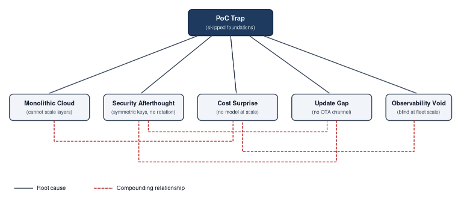
Figure 1. How the six failure modes compound. Solid arrows: root-cause relationships from the PoC Trap. Dashed arrows: compounding relationships between failure modes.
The PoC trap is the root cause. When a team rushes through proof-of-concept without building foundations, the other five failure modes emerge as consequences.
Pre-Production Checklist
Before promoting an IoT architecture from pilot to production, verify each of these items. Any item that is “planned for Phase 2” is a future incident waiting to happen:
☐ Device provisioning is fully automated (zero-touch via DPS) — a new engineer can provision 100 devices without manual portal interaction
☐ Device identity uses X.509 certificates or hardware-backed attestation — no shared symmetric keys in production firmware
☐ Firmware update mechanism is operational and tested at scale — at least one staged rollout (10% → 50% → 100%) has been executed successfully
☐ Cost model accounts for message billing boundaries, twin operations, and storage tiering — the model has been validated against at least one month of actual Azure billing
☐ Fleet-scale observability is in place (health, latency, error rates) — the on-call team can distinguish a device problem from a pipeline problem in under 5 minutes
☐ Architecture is layered with independent scaling per tier — telemetry ingestion can scale without redeploying the dashboard
☐ Security has been assessed with a formal threat model — at minimum, a STRIDE analysis covering device, edge, ingestion, and cloud layers
☐ Operational runbooks exist for common failure scenarios — at least: device certificate expiration, IoT Hub throttling, stream processor backlog, and regional connectivity outage
What to Do Before Your Next Pilot Ends
The next time a pilot asks for production approval, don’t ask whether the demo works. Ask whether the team can answer these questions without whiteboarding:
- How does a new device join the fleet without human intervention?
- What happens to telemetry when the stream processor falls behind?
- When do device certificates expire, and how are they replaced?
- Which 10% of messages go through real-time processing and which 90% go to storage?
- How does the on-call engineer know the difference between a device problem and a pipeline problem?
If the answers are “we’ll figure it out,” the pilot is not ready. It doesn’t mean the technology isn’t ready. It means the architecture hasn’t caught up to the scale it is being asked to support.
At Mesh Systems, we apply this checklist to every Mesh Cloud deployment before it moves from staging to production. We have found that the projects that pass all eight items on the first review are the projects that don’t generate 3 a.m. pages six months later.
What to Do Before Your Next Pilot Ends
- The PoC is a learning exercise, not a foundation. The architecture that serves 50 devices is structurally incapable of supporting 50,000. Treat the PoC as proof that the concept works, then build the production architecture from the reference model.
- Security cannot be retrofitted. Deploying devices with symmetric keys and deferring certificate management to “Phase 2” costs millions to remediate. X.509 certificates with DPS-based zero-touch provisioning are the production standard.
- Cost compounds non-linearly. IoT Hub’s 4KB message billing boundary, twin update overhead, and un-tiered storage can make production costs 2-10x the naive estimate. Build a cost model before scaling, not after the first bill arrives.
- The update channel is architecture, not a feature. A fleet without OTA updates is a fleet that cannot be secured. Treat firmware updates as a first-class concern from day one.
- Observability must span the physical and the cloud. Application Insights on the dashboard API tells you nothing about device health, message loss, or processing latency. Design observability into every layer.
Further reading: For a comprehensive treatment of these failure modes and the WAF assessment process, see Chapters 1 and 19 of Mastering IoT Solutions on Azure with the Well-Architected Framework.
Kyle Burns is a Practice Lead, Technical Principal at Mesh Systems.