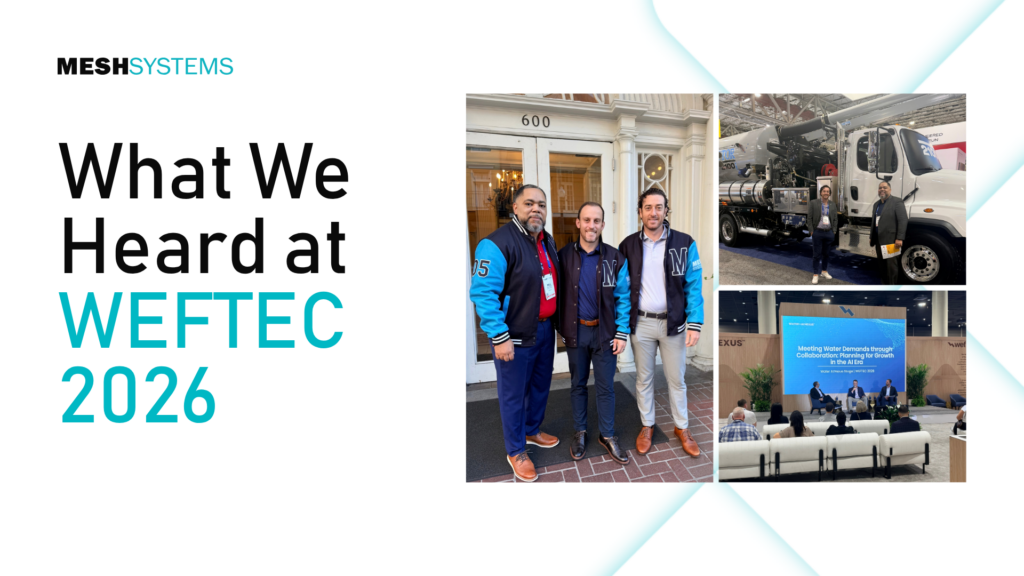
This week, the Mesh Systems team attended WEFTEC 2026 in New Orleans to meet with water technology manufacturers and learn how product and engineering leaders are approaching connectivity, digital services, and AI.
Compared with prior years, digital solutions were less prominent in many booths. The show floor remained centered on the physical equipment, systems, and infrastructure that keep water operations running. But in conversations with product and engineering leaders, digital capabilities were still very much top of mind.
What changed was the depth of the discussion. The broad excitement around AI was quieter, while the questions behind it were more specific: Is the product connected? Is the data reliable? Can service teams act on it? Is the underlying platform strong enough to support intelligence at scale?
Digital Was Less Visible but Still Strategically Important
Digital capabilities did not dominate booth messaging in the way they have at some recent industrial events. Many exhibitors led with equipment performance, reliability, efficiency, and application expertise rather than connectivity platforms or software offerings.
That did not mean digital strategy had disappeared. Product and engineering leaders were still thinking seriously about remote diagnostics, connected service, equipment data, and how digital capabilities could strengthen the customer experience. In many cases, those conversations simply happened beyond the primary booth pitch.
The absence of prominent digital messaging did not necessarily indicate a lack of interest. Finding the right product or engineering leader was often the key to understanding the real level of activity behind the scenes.
The AI Conversation Was Quieter and More Specific
AI generated less visible buzz at WEFTEC than it has at many other recent industry events. But the interest we encountered was deeper and more practical.
Instead of asking where AI could be added, leaders were more focused on the decisions it might improve. They wanted to understand how AI could help teams diagnose equipment issues, prioritize service needs, identify patterns across deployed assets, or guide the next best action using trustworthy operational data.
The strongest opportunities were tied to a defined decision or workflow, not AI as a standalone feature. The market appears to be moving beyond general awareness and toward the harder questions of implementation, evidence, and measurable value.
AI Cannot Compensate for a Fragile IoT Foundation
There was widespread recognition that many organizations still have foundational work to complete before AI can produce meaningful results.
Connected products need reliable device connectivity, usable telemetry, consistent data models, secure infrastructure, and service workflows that can turn an insight into action. If those pieces are incomplete, adding AI can create more alerts and more noise without improving the outcome.
The practical sequence matters. The first step may be connecting equipment that is still offline, improving data quality, or clarifying how diagnostic information reaches the service team. AI becomes valuable when it is built on that foundation and applied to a decision the business is prepared to act on.
Some Manufacturers Are Still Early in Connectivity
Several manufacturers we spoke with were still early in exploring connectivity, diagnostics, and connected service workflows. Their current model centered on selling equipment through distributors, which can limit direct visibility into how products perform after they enter the field.
That also creates practical opportunities to start small. A focused diagnostic use case, remote visibility for a critical asset, or a service workflow shared with distributors can demonstrate value while respecting the existing channel model.
Getting to the Right Product Conversation Mattered
WEFTEC also highlighted how differently manufacturers organize product development and technical expertise. Several companies had engineering firms operating as separate businesses that represented or supported the product. At other booths, representatives were focused on immediate equipment needs and were not directly connected to the teams responsible for digital strategy.
That made curiosity and context especially important. Conversations that began with the equipment, the customer, and the company’s current priorities created a more natural path to understand whether connectivity was already underway and who on the product or engineering team should be part of a deeper discussion.
What This Means for Water Technology Leaders
The clearest takeaway from WEFTEC 2026 was that interest in digital products and AI remains strong, even when it is not the headline on the show floor. The conversation is becoming more grounded in readiness, product ownership, and specific operational outcomes.
Manufacturers do not need to force AI into every product. They do need a clear view of their connected product foundation, the decisions their data could improve, and the service experiences customers increasingly expect. For some, that means advancing an existing strategy. For others, it means beginning with connectivity and diagnostics.
Mesh Systems helps manufacturers connect equipment, build and modernize connected product platforms, and apply AI to trusted machine data and real business decisions. If your team is evaluating where to begin or how to move an existing program forward, we would welcome the conversation.