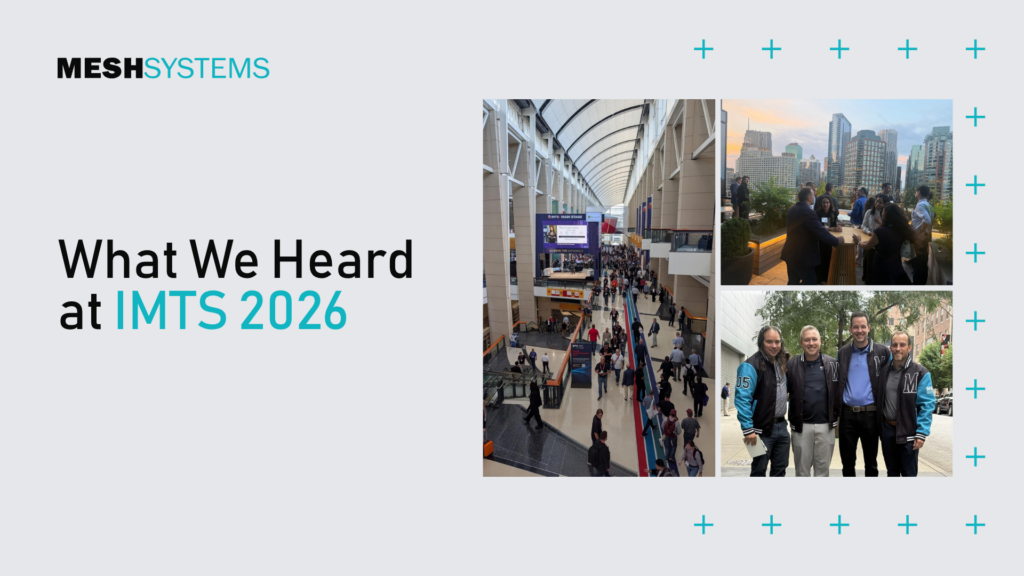
Mesh Systems was on the ground at IMTS 2026, meeting with manufacturing, product, and technology leaders across the show floor. We also hosted an IMTS Connected Product Leadership Dinner at Miru in Chicago, bringing together senior decision-makers from across the IoT and AI ecosystem for candid conversation and connection.
The biggest story at IMTS 2026 was not necessarily an entirely new generation of machines. It was how quickly powerful manufacturing technology is becoming easier for more people to use.
Across the show floor, AI-enabled solutions, robotics, scanning, laser systems, and advanced machining capabilities were everywhere. Exhibitors ranged from large multinational manufacturers to small local operations, while attendees represented machine shops, chemical companies, quality engineering teams, and many other corners of the manufacturing industry.
Despite that range, many conversations pointed to the same challenge: manufacturers need to do more with technology while relying on a workforce that may have less specialized experience than previous generations of operators.
The User Experience Is Becoming a Competitive Advantage
Many booths focused less on introducing a completely new cutting tool or robotic capability and more on simplifying the technologies that already exist. Interfaces are becoming more intuitive. Setup is becoming faster. Complex capabilities are being packaged into guided workflows that make the next step clearer for the person operating the equipment.
That shift matters because the value of advanced technology depends on whether people can use it confidently in real operating environments. A powerful machine with a steep learning curve can still create bottlenecks. A system that helps a new operator become productive sooner can deliver value much faster.
At IMTS, the learning curve appeared to be shrinking quickly. In many demonstrations, someone could move from little or no prior experience to cutting, scanning, or using a laser to create a project in a relatively short amount of time.
Workforce Pressure Is Shaping Product Design
The declining availability of traditional machine operators was a recurring theme in conversations. Manufacturers know they cannot always rely on finding people with years of specialized experience, and they cannot afford for critical knowledge to live with only a small number of employees.
As a result, equipment and software are being designed to carry more of that knowledge within the system itself. Guided processes, embedded recommendations, automated setup, clearer alerts, and easier access to operating information can help less-experienced employees make better decisions while reducing dependence on tribal knowledge.
This does not eliminate the need for skilled people. It changes where their expertise creates the most value. Experienced operators can spend less time navigating routine steps and more time handling exceptions, improving processes, and solving the problems that still require human judgment.
AI Is Moving Closer to the Operator
AI and AI-enabled solutions were visible throughout IMTS, but the most relevant applications were not broad promises about transformation. They were tools designed to make a specific task easier, faster, or more consistent.
In manufacturing environments, that may mean helping an operator interpret machine conditions, identify the likely cause of an issue, find the right procedure, or understand what action to take next. When AI is paired with connected equipment and reliable operational data, it can make complex information more useful at the moment a decision needs to be made.
The opportunity is not simply to add AI to a product. It is to use AI thoughtfully within the product experience so customers can get more value from the equipment, even as workforce experience levels vary.
Connected Products Can Help Close the Experience Gap
More intuitive physical equipment is only part of the answer. Connected products can also help manufacturers extend expertise beyond the individual operator or facility.
Remote monitoring, diagnostic data, service histories, digital workflows, and AI-driven guidance can give operators and support teams better context. They can also help OEMs understand how products are being used, where customers struggle, and which improvements could make the experience simpler over time.
For equipment manufacturers, ease of use is increasingly tied to the full connected product ecosystem. The machine interface, device data, cloud platform, service tools, and support experience all contribute to how quickly a customer can become productive and how confidently they can keep equipment running.
What This Means for Manufacturing Leaders
The larger takeaway from IMTS 2026 is that advanced manufacturing technology is becoming more accessible, intuitive, and useful to a broader group of people and companies.
As manufacturers respond to workforce constraints, the products that stand out will not only offer more capability. They will make that capability easier to learn, operate, support, and improve. For connected product leaders, that means designing technology around the decisions people need to make, then using connectivity, data, and AI to reduce friction at each step.
Mesh Systems helps manufacturers connect equipment, modernize connected product platforms, and turn device data into action. If you are exploring how connectivity and AI can make your products easier to operate and support, talk with our team.