Comparing IoT Device Management Platforms: What the Feature Checklist Won’t Tell You
Line up the usual IoT device management platforms side by side, Azure IoT Hub, AWS IoT Core, balena, Particle, and a dozen smaller names, and the feature checklists converge fast. Device provisioning, over-the-air updates, telemetry ingestion, fleet dashboards: most platforms cover the core features. A comparison built on a checklist of features tells a buyer almost nothing useful, because the boxes being checked are not where these platforms actually differ.
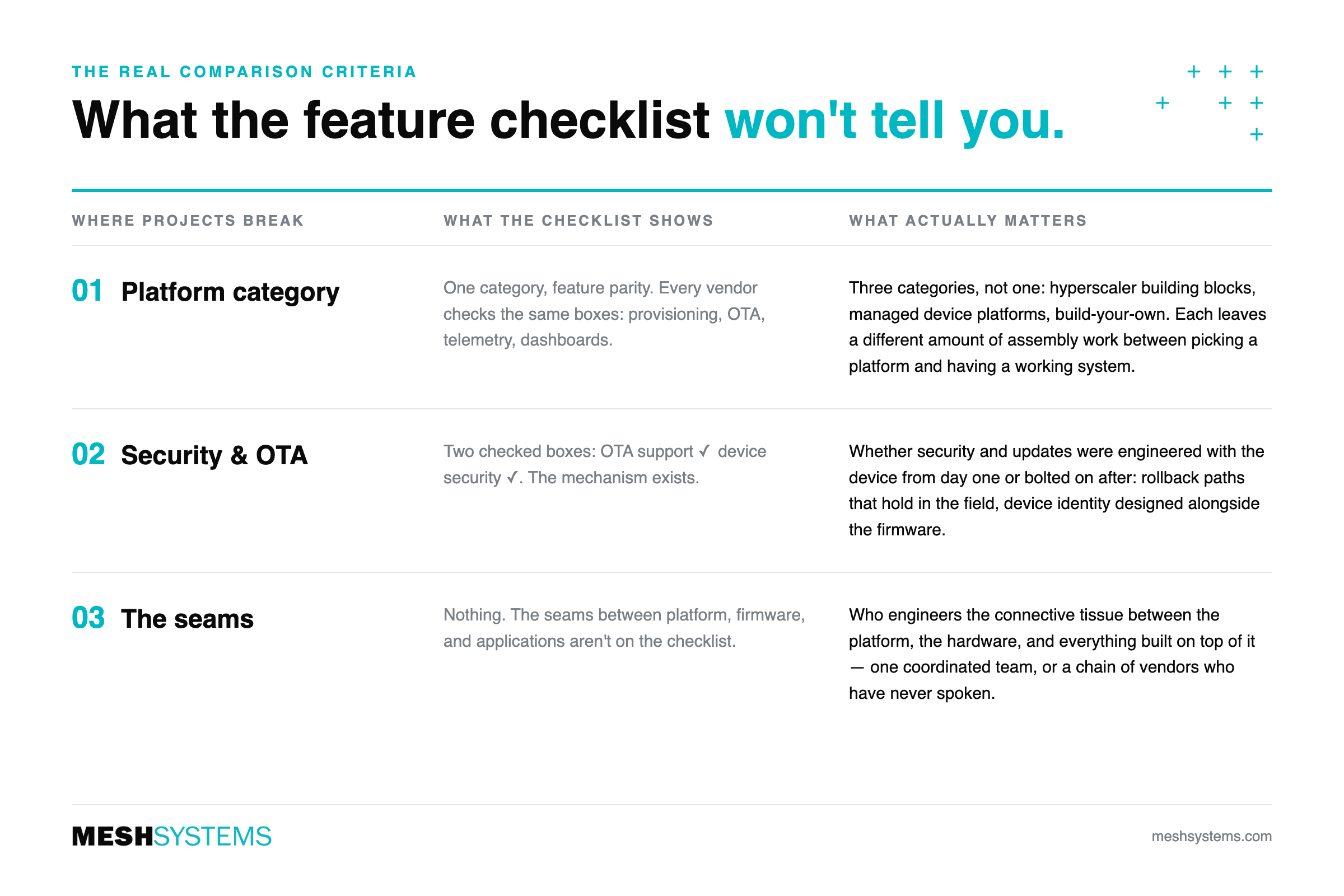
Where they differ, and where most projects actually run into trouble, is in three places the checklist does not measure:
Three Categories, Not One Feature Grid
Most comparisons treat device management platforms as one category. They are closer to three.
Hyperscaler platforms, with Azure IoT Hub and AWS IoT Core chief among them, offer deep and flexible building blocks for provisioning, updates, and telemetry. Some of those blocks are fully managed services, such as Azure Device Provisioning Service and Azure Device Update, and they take on a good deal of the heavy lifting. They are still building blocks, though. Someone has to connect them to the device firmware, the identity model, and the applications that sit on top, and that integration work decides whether the result behaves like one coherent device management system. Raw cloud compute works the same way: it is not an application until someone builds one on top of it.
Managed device platforms, balena, Particle, and similar names, trade some of that flexibility for speed. Fleet management, OTA, and provisioning come pre-assembled, which gets a team running faster, at the cost of more dependency on that specific platform’s roadmap and data model.
Build-your-own approaches on open frameworks, a custom MQTT broker, EdgeX, a homegrown backend, give maximum control and maximum engineering burden, and they describe more legacy IoT deployments than anyone would like to admit. Many of the systems that eventually need re-platforming started here.
Knowing which of these three categories a platform choice actually falls into matters more than any single feature on its data sheet, because it determines how much assembly work sits between choosing the platform and having a working device management system.
The Platform You Pick Is Not Permanent
Platform risk is not theoretical. Google discontinued Cloud IoT Core in 2023, and the companies that had built directly against it had to move their device fleets to a different platform on a timeline they did not choose. That is an extreme version of a risk every platform choice carries in some form: build directly on a vendor’s roadmap, and that roadmap becomes part of what gets inherited, including its end.
This is why the more useful comparison question is not “which platform is best to start on” but “which platform can this fleet grow into, and what does moving off it actually cost.” A team lands on a platform early more often than it chooses one deliberately, inheriting an on-prem broker or an early cloud deployment, and years later needs to move onto a modern, Azure-native foundation without a full rebuild. AWS-to-Azure, on-prem-to-cloud, SignalR-to-IoT Hub, monolith-to-containerized: these are real migration paths, not hypotheticals, and a platform that supports this kind of move without starting over is a better long-term choice than one that makes it a rebuild.
That is the situation MeshCloud was built for. MeshCloud is Mesh’s Azure-native IoT foundation, built on Azure IoT Hub, Azure Data Explorer and Fabric, Cosmos DB, and Event Hubs. It deploys into the customer’s own Azure environment and connects to Azure IoT Hub by default, while staying architected to consume from any broker, protocol, or data format, so it fits greenfield, brownfield, and integration scenarios alike.
Where the Checklist Stops Mattering: OTA and Security
Every platform on the comparison list claims over-the-air update support and device security. The checklist cannot say whether a firmware rollback path exists when an update fails in the field, or whether device identity was designed in alongside the firmware from the first commit, or added afterward to satisfy a certification requirement.
Security and update capability engineered in from day one behave differently in production than security and update capability added later. A platform’s OTA checkbox confirms a mechanism exists. It does not confirm whether that mechanism was built with the actual firmware architecture in mind, or whether it is a generic SDK feature the device team has to work around. Device security engineered in, not bolted on, is the standard worth holding any platform choice to. That standard covers protocol depth across cellular, Wi-Fi, BLE, and LoRa, edge logic that holds when the network does not, and device identity and update infrastructure designed alongside the firmware rather than after it.
Fleet Visibility Is a Different Problem Than Device Management
A device management platform manages devices. It is rarely where a fleet manager, a support team, or a field technician actually looks. That layer, the dashboards, the customer-facing apps, the APIs that stitch device data into the business systems that already exist, is a separate engineering problem that platform selection does not solve by itself.
Choosing a device management platform well does not automatically produce a usable fleet dashboard or a technician tool that makes sense in the field. That application layer has to be built cloud-native and engineered to scale on its own terms, turning device data into something people actually use regardless of which device management platform sits underneath it.
The Real Comparison Criteria
Connected products usually break at the seams when hardware, firmware, edge code, and platform are each engineered separately by different teams who rarely talk to each other. Platform selection rarely causes that failure by itself. The seam between the platform’s SDK and the firmware actually running on the device, or between the platform’s data model and the dashboard built on top of it, is where the failure actually shows up.
That makes the real comparison question less about which platform’s logo to pick and more about who is engineering the connective tissue between that platform, the hardware, and everything built on top of it, and whether that is one coordinated team or a chain of vendors who have never spoken to each other.
Mesh engineers every layer of that connective tissue, hardware and firmware through connectivity, edge, platform modernization, and application services, as one team rather than a series of vendor handoffs. More than 20 years doing this, over 5 million connected devices built or operated across global fleets, and one of the first IoT solutions built on Azure back in 2009 is less a line on a comparison chart and more the reason the seams tend to hold. That is the actual answer to which device management platform a team should choose: less about the platform, more about who is going to make the whole system work together once it is chosen.
MeshCloud
The Azure-native foundation for connected products.
If this comparison points toward building on Azure, MeshCloud is where Mesh starts. It is a modular, production-validated IoT foundation that covers device connectivity and lifecycle management, a high-volume ingestion pipeline load-tested to 1 million devices, digital twins and configuration, modern authentication, and built-in observability. It runs in your own Azure environment, and it gets devices connecting and operational dashboards live in days rather than the months it takes to rebuild the cloud foundation yourself.
Learn more about Mesh Systems’ solutions: