Most teams begin the search for an IoT cloud platform by comparing vendors. That is the wrong starting point. Every provider stresses a different strength such as connectivity, analytics, AI, speed to deploy, and each makes a credible case that its platform is the one you need. Compared side by side, they blur together.
The more useful question is not which vendor is best, but what kind of foundation your business requires. The costliest mistake in this category is choosing a platform sized for where you are today, when the use case is small and the platform feels close to complete, rather than for where you will be once the connected product is in the field at scale. This guide is built to help you make that call: first by mapping the landscape, then by narrowing it with a short set of questions that eliminate poor-fit options quickly.
What is an IoT cloud platform?
An IoT cloud platform is the layer that turns raw signals from connected devices into structured, secure, accessible data that applications and people can act on. It sits between the devices in the field and the software that creates business value, and it is responsible for capturing data reliably, storing it, making it query-able, and keeping the whole system observable and secure.
The important thing to understand is that this is not one thing. A complete connected product solution spans several distinct layers, and no single product covers all of them in the same way. Understanding those layers is what makes the vendor landscape legible.
An end-to-end IoT solution generally spans seven layers:
- Hardware: the devices, controllers, and modules in the field.
- Connectivity and network: how those devices reach the internet.
- Ingestion and routing: how device data is received and moved reliably at volume.
- Storage: where time-series, event, and configuration data are kept and made query-able.
- Device management: provisioning, grouping, updates, and lifecycle across the fleet.
- Application: the portals, dashboards, and custom software your users interact with.
- Insights: visualization, analytics, and the AI layer that turns data into decisions.
Every platform on the market covers some band of this stack. The differences between vendors are largely differences in which layers they own, which they assume you will bring, and which they leave you to stitch together.
The IoT platform landscape, by layer
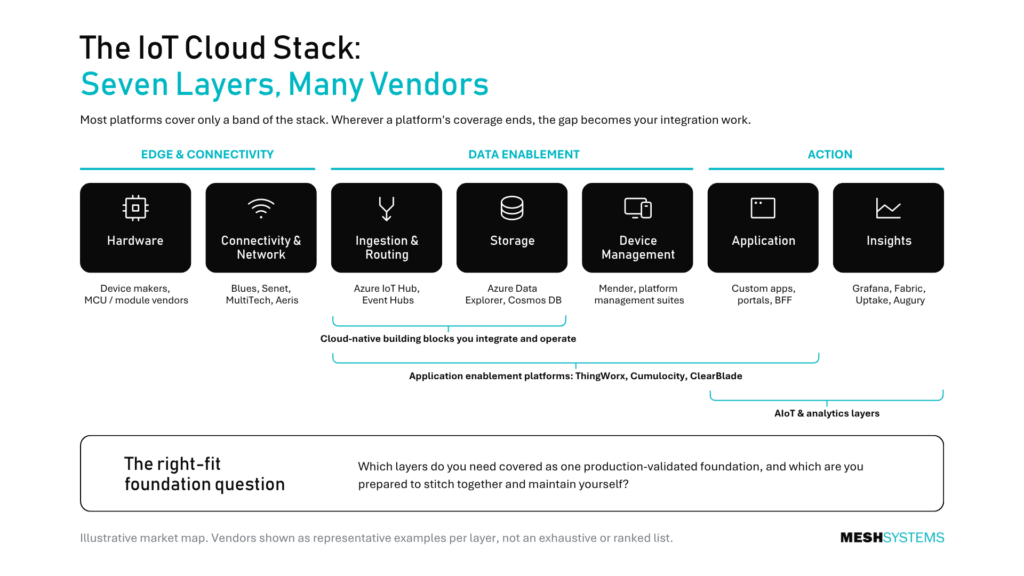
Because vendors cover different parts of the stack, the clearest way to map the market is by layer rather than by brand. The graphic below shows the seven layers, representative vendors that operate at each, and the way certain platforms span several layers at once.
Edge and connectivity
At the base of the stack, hardware vendors supply the devices and modules, while connectivity providers such as Blues, Senet, MultiTech, and Aeris handle how those devices reach the network. These layers are foundational, establishing the reliable link between the physical device and everything that happens with its data further up the stack.
Data enablement: ingestion, storage, and device management
This is the middle of the stack, and it is where most of the real platform work happens. Cloud-native building blocks such as Azure IoT Hub, Event Hubs, and Azure Data Explorer provide ingestion, routing, and storage, but they are components you assemble and operate yourself rather than a finished foundation. Device-management tools such as Mender cover updates and lifecycle for part of the fleet.
Application enablement platforms including PTC ThingWorx, Cumulocity, and ClearBlade span from ingestion through management and into the application layer. They offer the broadest single-vendor coverage of this band, which is their appeal. The trade-off is that breadth is delivered through configuration surfaces and packaged features, which can be fast to start with but harder to shape when your use case diverges from the platform’s defaults.
Action: application and insights
At the top of the stack, the application layer is where custom portals and software live, and the insights layer is where data becomes decisions. Visualization tools such as Grafana and Microsoft Fabric, and AIoT and analytics platforms such as Uptake and Augury, operate here. This layer is where differentiation is ultimately won, but it is also where many connected product programs stall. Teams rush to build a portal and then ask busy people with day jobs to interpret dashboards, decide what to do, and go act on it, which turns the application layer into a bottleneck and often produces no action at all. The more durable approach keeps the focus on outcomes: use this layer to drive decisions and action directly, rather than making the customer the last mile of the workflow.
The pattern across the whole map is consistent: most platforms cover a band, not the entire stack. Wherever a platform’s coverage ends, the gap becomes your integration and maintenance responsibility.
Four questions that narrow the field
Once you see the landscape as layers rather than brands, a short set of questions does most of the work of eliminating poor-fit options.
- How many layers do you need covered as one foundation? A solution that spans more of the stack means less to integrate and maintain yourself. Be honest about which gaps your team is genuinely equipped to own.
- Are you buying software, or software and the expertise to run it? Pure software platforms hand you capability and leave operation to you. If your team is small or you are piloting an early IoT solution, the expertise to deploy and run the platform matters as much as the platform itself.
- Who needs to own the tenant and the data? Some deployment models keep data and governance in your own cloud environment; others host everything for you. This choice affects control, compliance, and how exposed you are to vendor lock-in.
- What must hold up at scale, not just at prototype? A platform that feels complete during a small pilot can solve only a fraction of the problem once the fleet grows. Evaluate the scale you are building toward, not the one you are starting from.
The trade-off nobody names: underfit versus overfit
Beneath the vendor comparisons is a structural problem that rarely gets discussed openly. Off-the-shelf IoT platforms tend to fail in one of two directions.
Underfit platforms give you less than you need. You spend the engagement bolting on services and custom work to cover the gaps between what the platform does and what your business requires.
Overfit platforms give you more than you need. You pay for features you will never use and live with rigidity you never asked for, because the platform was shaped around someone else’s use case.
The illusion is that this is a fixed choice you make once. In practice, it changes over time, and it gets worse. A platform feels close to complete at prototype, when the use case is small and simple. By the time you reach scale, that same platform solves a fraction of the problem, and everything beyond it is custom work or migration. The gap between what the platform covers and what your business needs widens exactly as the stakes rise.
A right-fit foundation works the other way around. It starts lean, covers the layers you genuinely need as a production-validated whole, and gets stronger as your business grows into it (rather than weaker as your business grows past it).
Where MeshCloud fits among the options
Set against that landscape, MeshCloud is a foundation for the data-enablement layers of the stack: connectivity, ingestion, routing, storage, device management, observability, and security. That foundation is delivered as a single, production-validated whole rather than components you assemble yourself.
It is Azure-native and built on proven building blocks, and it is designed to be a foundation rather than a black box: modular components you can take or leave, extension points exposed down to source code where scoped, and your differentiated application and insights layers built on top rather than boxed in. You keep ownership of your data, your applications, and your integrations, deployed in your own Azure tenant or hosted by Mesh, with no lock-in by design.
Where it differs from most options on the map is the coverage and support model. Rather than a narrow layer you extend yourself or a broad platform you configure around, MeshCloud is a right-fit foundation across the enablement layers, backed by more than twenty years of connected product engineering. The layers you need are covered, and the gaps do not become your problem to maintain.
A short buyer's checklist
Whichever direction you go, use these questions to pressure-test any IoT cloud platform before you commit:
- Which layers of the stack does this platform actually cover, and which am I responsible for stitching together?
- Does it hold up at the scale I am building toward, or only at pilot?
- Do I keep ownership of my tenant, my data, and my integrations?
- Can I shape it to my use case, or am I limited to its configuration surfaces?
- Am I getting software alone, or software plus the expertise to run it?
- How exposed am I to lock-in, rising fees, or forced migration if the platform is sunset?
- Is it ready for the AI and analytics layer I will want next, or does that become another integration project?
The right platform is the one whose coverage matches the layers your business needs, holds up as you scale, and leaves you in control of what makes your connected product yours. Talk to an expert to see how a right-fit foundation maps to your connected product.